
TL;DR
Sovereign and regulated organizations need GRC programs that can keep pace with continuously evolving risk across air-gapped, OT-heavy, classified, and distributed environments. Traditional GRC tools rely on manual evidence collection, rigid integrations, and periodic assessments, leaving teams with fragmented visibility and delayed assurance. 6clicks iGRC shifts compliance from static checklists to continuous, AI-powered sovereign assurance by capturing evidence from any source, applying contextual intelligence, and unifying risk, controls, remediation, and audit readiness in one platform.
Governments, defense organizations, and critical infrastructure operators are navigating an unprecedented mix of pressures: rising cyber threats, expanding technology stacks, growing regulatory expectations, and the rapid introduction of AI into operational models. At the same time, many environments remain partially or fully air-gapped, OT-heavy, classified, or constrained by national data sovereignty requirements.
Traditional GRC models and tools designed for commercial IT are not equipped to support these realities. 6clicks iGRC addresses this gap, enabling the shift from manual, document-driven, and connectivity-dependent workflows to sovereign, AI-powered, and continuous assurance across complex, regulated environments. Let’s unpack why and how.
The current state of GRC in regulated and sovereign environments
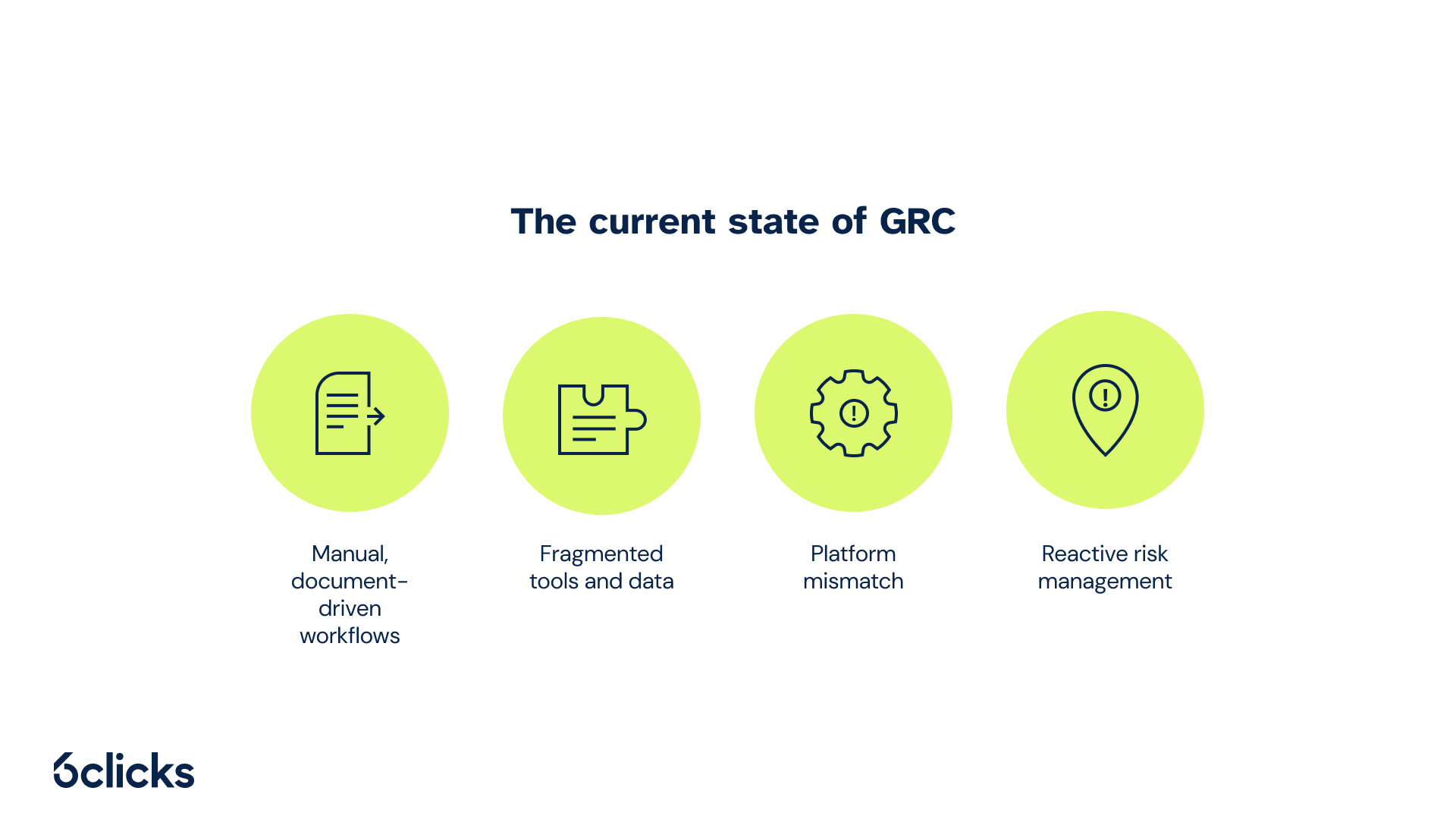
Today, most GRC programs remain reactive, document-driven, and heavily manual. Across sovereign environments, GRC typically looks like this:
- Evidence collected manually through screenshots, exports, PDFs, and emails
- Assessments performed periodically rather than continuously
- Controls reviewed annually or during audit cycles
- Risk registers updated after incidents or formal reviews
- Remediation tracked in spreadsheets or disconnected systems
- Frameworks like ISO/IEC 27001 and NIST SP 800-53 are implemented as static checklists rather than living operational models
Instead of continuous oversight, teams are left stitching together fragmented views of risk from isolated sources. This problem is amplified in sovereign contexts, where:
- Evidence lives across disconnected IT and OT systems
- Networks may be partially or fully air-gapped
- Data is distributed across agencies, facilities, or jurisdictions
- Classified or restricted environments prevent traditional integrations
The GRC market: Built for enterprises, not sovereign operations
The current tooling landscape further reinforces these challenges. Most GRC platforms fall into one of two categories:
-
Legacy platforms were built primarily as governance and audit repositories. They offer limited automation and rely heavily on manual data entry and reporting. Evidence ingestion is slow. Risk context is shallow. Remediation workflows are often external to the platform.
-
Newer automated platforms promise efficiency but come with rigid assumptions. They depend on predefined integrations, cloud connectivity, and standardized system architectures. If your environment does not fit their connector model or operates offline, large parts of your technology stack simply disappear from view.
Across both categories, common gaps persist:
- Little support for unstructured or offline evidence
- No native centralization across agencies, entities, or facilities
- Limited or absent multi-tenancy for federated programs
- Poor visibility across hybrid IT and OT environments
- Fragmented tooling for evidence, risk, remediation, and audit readiness
For sovereign organizations managing national infrastructure, defense systems, or regulated public services, these are structural blind spots.
The operational consequences of static GRC
The result is a widening gap between regulatory intent and operational reality, leading to:
- Slow evidence collection across restricted systems
- Fragmented risk visibility with no single source of truth
- Manual consolidation from spreadsheets and siloed tools
- Delayed remediation as issues surface weeks or months later
Compliance becomes episodic. Assurance becomes manual. Risk is assessed after the fact. Teams spend more time assembling artifacts for audits than understanding their real-time posture.
But risk in sovereign environments does not wait for annual reviews or quarterly assessments. It evolves continuously across critical infrastructure networks, supply chain dependencies, and converging IT and OT.
Introducing 6clicks iGRC: Assurance that adapts to sovereign
reality
6clicks represents a shift away from static compliance toward continuous, operational assurance. It delivers unified GRC operations, centralized governance, and real-time compliance validation across complex, federated, and air-gapped environments.
Unlike conventional GRC tooling that assumes always-on cloud access, 6clicks operates within your organization’s security perimeter, including on-premises infrastructure, air-gapped or restricted networks, and hybrid deployments. It fits sovereign environments rather than forcing them to conform to rigid tools and integration models.
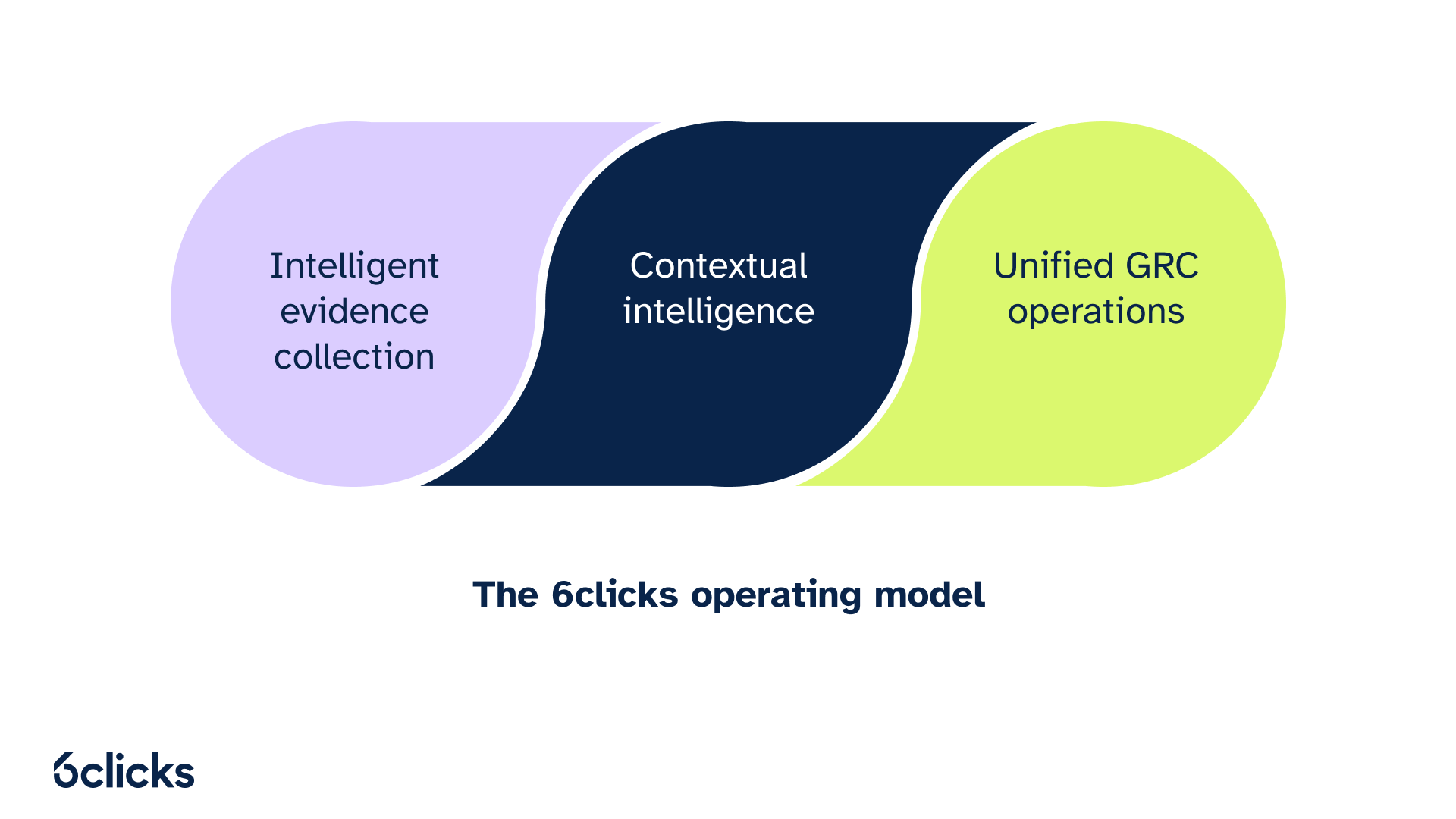
At its core, the 6clicks platform is built on three foundational pillars:
Intelligent evidence collection and validation
With 6clicks, the process starts by removing the assumption that evidence must arrive through predefined integrations or cloud connectors.
Instead, evidence can be captured from anywhere:
- Structured and unstructured sources
- Logs, screenshots, exports, documents, and databases
- IT, OT, legacy systems, and restricted environments
Leveraging AI built into the platform and deployed within the organization's environment, this approach automates evidence collection without relying on cloud connectivity or external services. Hailey AI connects to any system by generating custom integration recipes that run via the built-in, no-code Workflow Builder in the platform. Once your systems are connected, tests are automatically polled with the corresponding evidence written back to the control record. With each new evidence or control test, compliance status updates across linked requirements, assets, and frameworks.
This enables continuous monitoring even in bespoke or disconnected environments, empowering sovereign organizations to bring operational reality into GRC as-is, without reshaping architecture to fit the platform.
Contextual intelligence + knowledge that scales
When it comes to control testing, 6clicks goes beyond binary pass/fail controls with its powerful GRC Knowledge Graph. Once evidence is ingested and understood, Hailey AI applies organizational and operational context to turn signals into assurance.
As a result:
- Controls are evaluated based on intent and operational reality
- Exceptions and control drift are surfaced in context
- Assurance reflects current conditions, not point-in-time snapshots
- Evidence automatically maps to controls to frameworks to assets, with results and decisions flowing across all frameworks
- Organizational knowledge compound as your program grows
This moves GRC from static compliance toward situational awareness, enabling earlier intervention and more defensible oversight.
Runs where your data lives + unified GRC operations
Finally, the 6clicks platform deploys where your data and obligations demand, ensuring GRC capabilities remain consistent regardless of your infrastructure or environment. It connects evidence, assessment, remediation, and audit readiness into a single continuous workflow. It also centralizes oversight across regulated entities or regional facilities through a Hub & Spoke architecture, allowing central teams to maintain visibility while local operators manage controls and remediation within their own environments.
Rather than fragmented tools, incompatible integrations, and manual handoffs, organizations gain:
- Universal connectivity
- Connected compliance registers for core GRC records
- Real-time posture visibility
- Always-on audit readiness
By unifying risk, controls, frameworks, assets, evidence, and assessments in one platform, GRC becomes an operating system for sovereign assurance, not a reporting layer.
Who the platform is built for
6clicks brings together flexible evidence ingestion, intelligent reasoning, and end-to-end GRC workflows into a single operating model, replacing fragmented stacks such as:
- Evidence collection tools
- Continuous controls monitoring platforms
- Assessment systems
- Audit preparation workflows
- Standalone risk registers
This unified approach is designed specifically for organizations operating in constrained, regulated, and high-consequence environments, including:
- Government agencies managing federated compliance programs
- Defense organizations operating in classified or air-gapped environments
- Critical infrastructure operators with OT-heavy environments
- Regulators requiring continuous supervisory insight
- Sovereign enterprises managing multi-entity risk
Overall, 6clicks provides one sovereign-ready system that runs assurance end to end, from evidence capture through remediation and audit readiness.
The future of sovereign assurance: Beyond static compliance
to adaptive operational resilience
Sovereign environments demand more than periodic assessments and disconnected tools. As risk evolves across federated, air-gapped, and operational systems, assurance must become continuous.
6clicks makes this possible by unifying evidence, intelligence, and operations into a single sovereign-ready model:
- Capture evidence from any source
- Apply AI-driven context to understand risk
- Maintain continuous visibility across entities or regions
- Run remediation and audit readiness as one workflow
It’s time to move beyond compliance projects and operate assurance as a sovereign capability. Make the shift now.