.svg)
TL;DR
- UK regulation is moving from documented compliance to demonstrable control across cyber resilience, data protection, and financial-services operations.
- The Critical Third Parties regime makes cloud dependency a board-level resilience issue, but accountability still sits with regulated firms.
- The Cyber Security and Resilience Bill raises expectations for incident reporting, enforcement, and cyber resilience evidence across essential services.
- GovAssure and the NCSC Cyber Assessment Framework make assurance outcome-led, evidence-based, and increasingly relevant to public-sector and critical-service suppliers.
- Annual reviews break down on lag, drift, and false confidence, which is why point-in-time compliance no longer holds up.
- 6clicks helps UK organisations move to continuous assurance through automated evidence collection, third-party risk management, AI-powered control mapping, and board-ready reporting.
In the UK, sovereignty is no longer just a question of where infrastructure sits. In 2026, it is about whether organisations can prove they remain in control of the services, systems, and third parties they rely on.
That shift is clearest in financial services. The UK Government has designated four major cloud and technology providers as Critical Third Parties in July 2026, bringing them under oversight by the Bank of England, PRA, and FCA because of their systemic importance to the UK financial sector. The new CTPs are Microsoft Ireland Operations Limited, Google Cloud EMEA Limited, Amazon Web Services EMEA SARL, and Oracle Corporation UK Limited.
However, direct oversight of a provider does not transfer accountability away from the firm. The FCA makes it clear that the regime complements, but does not replace, existing outsourcing and operational resilience rules. Firms remain responsible for due diligence, risk management, contingency planning, and control over their own third-party arrangements.
Your provider may be critical, but the accountability is still yours.
The Cyber Security and Resilience Bill widens the proof perimeter
The UK’s Cyber Security and Resilience Bill is progressing through Parliament in 2026 and is designed to strengthen national cyber defences and protect essential public services. Government materials point to expanded and more timely reporting of harmful cyber attacks, stronger information sharing, cost recovery, and enforcement.
For UK organisations, the message is simple: cyber resilience can no longer sit in a static policy pack. Essential services, digital supply chains, and incident readiness all need evidence that controls exist and work when disruption happens.
The Bill also reinforces the role of the NCSC Cyber Assessment Framework, already used to assess cybersecurity and resilience outcomes for organisations operating essential services. The direction of travel is clear: assurance is becoming more outcome-led, more evidence-led, and harder to satisfy with annual declarations alone.
GovAssure raises the bar for public-sector assurance
GovAssure assesses UK government critical systems against the NCSC Cyber Assessment Framework. It is designed for OFFICIAL government systems, including government-sector critical national infrastructure, and gives organisations better visibility of cybersecurity risks so they can manage them more effectively.
For public-sector bodies and suppliers to critical services, this makes “from documented to demonstrated” tangible. Assurance is becoming a repeatable operating model: assess, evidence, remediate, report, and improve.
The same principle applies across the UK sovereignty conversation. Data, systems, and services may sit across multiple environments, providers, and delivery models. The organisation still needs to demonstrate that risks are being managed, controls are aligned to expected outcomes, and gaps are tracked through to remediation.
Annual snapshots do not survive operational reality
The UK market is moving from declarations to evidence. Critical Third Parties, the Cyber Security and Resilience Bill, GovAssure, and NCSC CAF all point in the same direction: regulators, boards, and customers want proof of control, not just documentation.
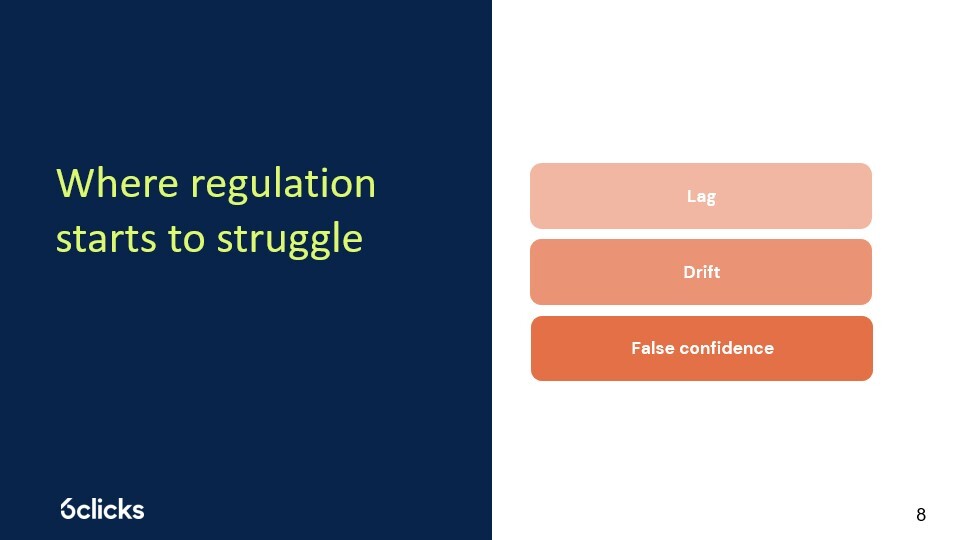
Annual reviews fail on three fronts:
- Lag. Evidence is collected and reviewed after the environment has already changed.
- Drift. Systems, suppliers, incidents, and controls move faster than static documentation.
- False confidence. A clean assessment can create comfort without proving that controls worked when they mattered.
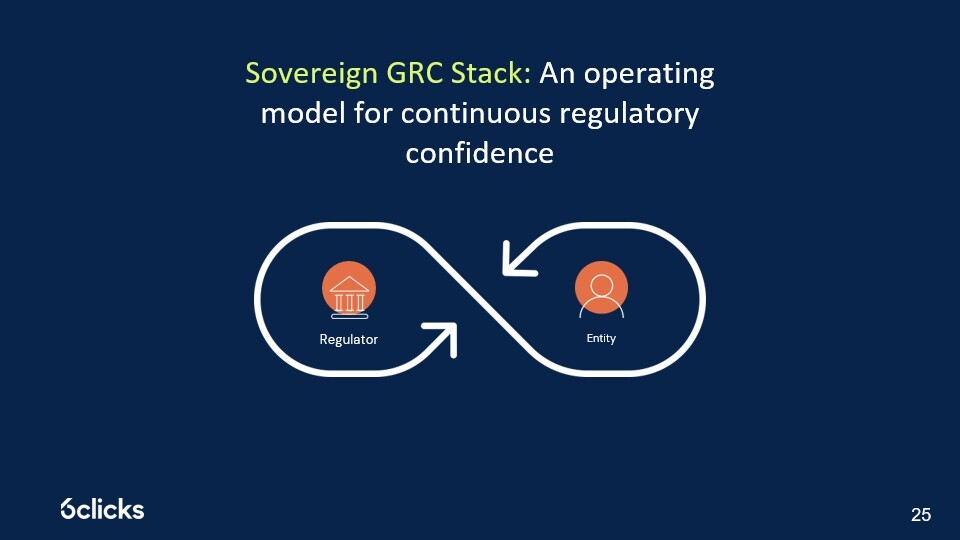
For UK organisations, sovereignty is becoming less about ownership of infrastructure and more about evidence of control. Ready for Sovereignty means having a live, connected view of obligations, controls, third parties, risks, incidents, evidence, and reporting.
From documented to demonstrated
Being “Ready for Sovereignty” in the UK means continuously demonstrating control across cloud dependency, cyber resilience, and public-sector assurance.
The question is no longer whether a provider is regulated, local, or resilient. The question is whether the organisation can prove its own control over the dependency — before an incident, during disruption, and when evidence is requested.
That is where continuous assurance becomes the operating model.
How 6clicks can help you
6clicks helps UK organisations build the continuous, defensible proof that modern sovereignty, resilience, and third-party accountability now demand:
-
- Continuous evidence collection (iGRC). Pull evidence from connected systems, upload it manually where needed, and map it to controls so assurance does not depend on last-minute audit chasing.
- Third-party risk management. Centralise vendor and provider information, due diligence, assessments, findings, remediation, and ongoing monitoring across critical third-party relationships.
- Sovereign GRC infrastructure. Run GRC where your data and operating model require it, including sovereign, restricted and high-assurance environments.
- Integrated GRC. Connect risks, controls, frameworks, assessments, incidents, third parties and reporting in one operating model rather than managing assurance across disconnected tools.
- Hub & Spoke. Give central teams oversight while allowing business units, entities and regions to manage their own local execution.
- Hailey AI. Accelerate control mapping, evidence workflows and multi-framework alignment so teams can reduce duplicate work and focus on decisions.
- ISO 42001 and AI governance. Build structured AI governance and evidence workflows as UK and EU AI expectations continue to evolve.
Ready for Sovereignty? See how 6clicks helps UK organisations move from documented compliance to demonstrated assurance through continuous evidence, connected controls and board-ready oversight. Speak with our team.