.svg)
TL;DR
- The revised Federal Act on Data Protection (FADP) has moved data governance to a board-level priority, with directors personally accountable.
- Digital sovereignty is now a live commercial issue, with data location and access control treated as non-negotiable for Swiss customers.
- FINMA's operational resilience and data expectations mean firms must evidence both where data lives and whether controls actually work.
- 2026 assurance guidance calls for defensible, continuously monitored evidence, not once-a-year attestations.
- Annual audits break down on three fronts: lag, drift, and false confidence, which is why point-in-time compliance no longer holds up.
- 6clicks provides continuous evidence collection, AI-driven mapping of FADP, GDPR, and ISO 27001, and single-source oversight across entities.
In Switzerland, sovereignty just became a board-level proof
problem
Swiss organisations have long treated data protection and financial-sector resilience as steady-state governance. With the law's enforcement in 2023 and ongoing FDPIC guidance shaping regulatory expectations through to 2026, compliance with the revised Federal Act on Data Protection (FADP) has "moved from a background governance task to a board-level priority": directors are now personally accountable for demonstrable data governance.
At the same time, digital sovereignty has become a live commercial conversation. Microsoft published its Swiss sovereign-cloud portfolio in February 2026, underscoring that data location and access control are now "non-negotiable" for Swiss customers.
FINMA raises the operational resilience bar
For financial entities, FINMA's operational risk and resilience expectations, alongside data-sharing and residency requirements, mean firms must show control over where data lives and whether controls actually work.
Switzerland's "add-ons" to GDPR-style rules make this harder, not easier: you can't simply reuse an EU control set and assume you're covered.
Annual snapshots don't survive contact with a Swiss regulator
PwC's Risk Agenda for Assurance Functions 2026 (Swiss edition) makes the shift clear: assurance teams are expected to move beyond point-in-time testing toward continuous monitoring and risk management, with clear evidence that controls are implemented, effective, and overseen. Across the market, 2026 is the year continuous assurance became the operating model: the question is no longer what you deployed, but whether you can prove your controls are working right now.
Why annual audits fail: lag, drift, and false confidence
Across 6clicks' global Ready for Sovereignty tour, one diagnosis resonated in every room: annual audits were built for static, deterministic systems, and today's environments are neither. For Swiss firms answering to FINMA and to personally accountable boards, three failure modes explain why point-in-time compliance no longer holds up:
- Lag. Evidence is collected, then reviewed long after the fact. By the time an audit report lands, the system has already changed, so you are assuring a snapshot that no longer exists.
- Drift. Production environments diverge from documentation continuously. Configurations change, policies update, and AI-enabled systems widen the gap between what is written down and what is actually running.
- False confidence. Assurance exists on paper, everyone feels safe, and then something goes wrong. A clean annual report is not the same as a control that was working on the day it mattered.
For FADP accountability and FINMA-grade resilience, this is the crux: directors cannot certify what they cannot see in real time. Continuous, connected evidence closes the lag, catches the drift, and replaces false confidence with proof.
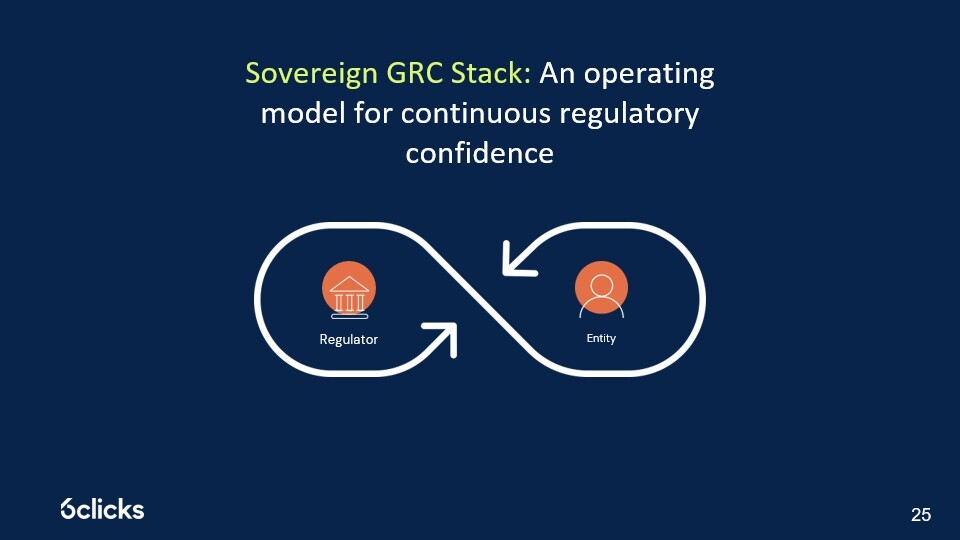
From documented to demonstrated
Being "Ready for Sovereignty" in Switzerland means continuously demonstrating data control, FADP accountability, and FINMA-grade resilience, with evidence, not binders.
How 6clicks can help you
6clicks gives Swiss teams the continuous, defensible proof that FADP and FINMA now expect:
- Continuous evidence collection (iGRC). Automatically capture and map evidence to controls so data governance and resilience claims are always provable.
- FADP + Swiss add-ons, mapped by AI. 6clicks' Hailey AI reconciles FADP, GDPR, and ISO 27001 automatically, so you cover the Swiss-specific deltas once instead of duplicating work.
- One platform for every entity and jurisdiction. 6clicks' Hub & Spoke model lets Swiss groups manage FADP, FINMA, and cross-border obligations from a single source of truth.
- FINMA operational resilience monitoring. Continuous control monitoring and incident tracking aligned to FINMA operational risk expectations.
- Data residency & sovereignty visibility. Evidence where data lives and who can access it, the distinction Swiss regulators care about.
- Board-ready assurance. Real-time dashboards that give directors the demonstrable oversight now expected at board level.
Ready for Sovereignty? See how 6clicks moves you from documented to demonstrated compliance. Speak with our team.