.svg)
TL;DR
- Canada's 2026 sovereignty conversation is no longer just about where data is hosted; it is about whether organizations can prove control over data, AI systems, third parties, and critical operations.
- Data residency alone does not equal sovereignty: Canadian organizations need evidence of who can access data, which obligations apply, and whether controls are actually working.
- AI regulation is still forming after AIDA was prorogued, but PIPEDA, Quebec Law 25, OSFI expectations, and international exposure already create governance and evidence obligations.
- OSFI E-21 makes operational resilience a 2026 proof point, requiring federally regulated financial institutions to identify critical operations, set tolerances and begin scenario testing.
- Annual audits and static documentation break down on lag, drift, and false confidence, which is why point-in-time compliance no longer holds up.
- 6clicks provides continuous evidence collection, AI-driven control mapping, third-party visibility, and board-ready assurance through an integrated GRC model.
For organizations, sovereignty has become an operating model, not a hosting claim. It is no longer enough to say data is “in Canada.” Teams need to understand what data they hold, where it moves, who can access it, which third parties support it, which obligations apply, and what evidence proves controls are working.
In other words, sovereignty has become an evidence problem.
The sovereignty question has changed
For years, data sovereignty conversations in Canada have often started with a simple question: Where is the data stored? In 2026, that question is no longer enough.
A more useful question is: who controls the data, who can access it, under what conditions, and how can the organization prove those controls are working?
That shift matters because server location alone does not guarantee sovereignty. A 2026 ITIF report on Canadian cloud policy argues that Canada’s cloud debate should focus less on domestic ownership or physical server location and more on control in practice. BLG’s 2026 analysis of data sovereignty and the CLOUD Act makes the same point: storing data in Canada can reduce some risks, but it does not automatically eliminate exposure to foreign legal access regimes. Corporate structure, operational control, data sensitivity, legal exposure, and access conditions all shape the real sovereignty risk.
Canada’s AI law may still be forming, but the proof burden is already here
Canada does not currently have an AI-specific statute in force. The Artificial Intelligence and Data Act, which was part of Bill C-27, died on the order paper in January 2025 and has not been reintroduced. A successor is expected, but 2026 commentary suggests it will not simply be a repeat of AIDA.
That does not mean organizations can wait. AI governance obligations are already emerging through existing privacy, financial services, and international requirements. PIPEDA continues to govern personal information used in AI systems. Quebec’s Law 25 adds transparency expectations around automated decision-making. OSFI guidance is relevant for federally regulated financial institutions using models and technology in risk-sensitive environments. Canadian organizations serving EU markets may also need to account for EU AI Act obligations.
The practical takeaway is clear: even without a single Canadian AI statute, organizations still need to prove that AI governance is working. That means maintaining inventories, risk classifications, oversight, testing records, vendor due diligence, and evidence of policy enforcement before the next regulatory wave arrives.
Privacy turns sovereignty into an operational discipline
Sovereignty is often discussed in terms of jurisdiction, but privacy makes it operational.
If an organization cannot explain how personal data is collected, processed, accessed, transferred, retained, and used in automated decisions, it cannot credibly claim control. This is especially important in Canada, where PIPEDA still applies at the federal level and Quebec’s Law 25 continues to raise expectations for transparency, accountability, and privacy governance.
The issue is not just whether a privacy policy exists. It is whether teams can demonstrate where personal information is used, which systems process it, which third parties access it, whether automated decision-making is involved, and whether the right controls are operating as intended.
This is where static documentation starts to break down. Privacy, AI governance, and sovereignty are too interconnected to manage through disconnected spreadsheets, point-in-time assessments, or policy repositories alone.
OSFI E-21 makes resilience a 2026 evidence deadline
For Canadian financial institutions, OSFI Guideline E-21 gives the sovereignty and assurance conversation a concrete deadline.
OSFI expects full adherence to Guideline E-21 by 1 September 2026. The guideline covers operational risk management, operational resilience, business continuity risk management, crisis management, change management, and data risk management. OSFI’s implementation expectations also make clear that institutions should have completed identification, mapping, and tolerance-setting for critical operations by that date, and should have developed scenario-testing methodology and begun the testing process.
That is a major shift from resilience as a documented plan to resilience as a demonstrated capability. Institutions need to show they understand their critical operations, the systems and third-party risk those operations depend on, their disruption tolerances, their control environment, their scenario-testing approach, and the evidence that supports leadership oversight and board reporting.
This is the same pattern seen across sovereignty, AI, and privacy: the requirement is moving from “have a policy” to “prove the operating model works.”
Continuous assurance is the missing link
The common thread across Canada’s 2026 market signals is evidence.
Sovereignty asks: Can we prove control?
AI governance asks: Can we prove oversight?
Privacy asks: Can we prove responsible data handling?
Operational resilience asks: Can we prove the organization can continue critical services under stress?
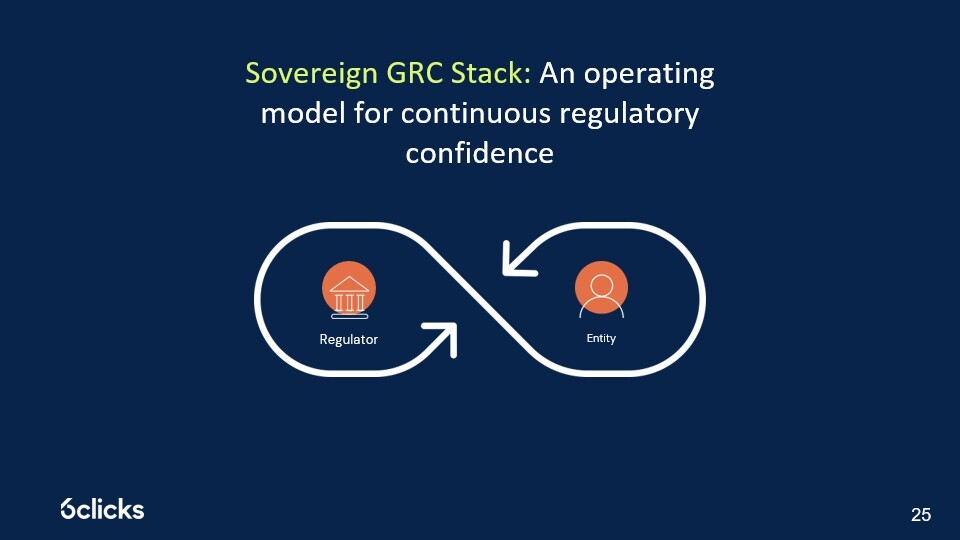
The answer cannot be a one-time assessment or a static document. It needs to be a continuous assurance model, one where obligations, risks, controls, evidence, and reporting stay connected over time.
This is the real opportunity behind “Ready for Sovereignty.” Being ready is not just about selecting the right hosting model or writing the right policy. It is about having the assurance infrastructure to prove control as regulations, technologies, third parties, and business conditions change.
From documented to demonstrated
Canada’s 2026 sovereignty conversation is becoming more practical, more operational, and more evidence-driven. Data location still matters, but it is only one part of the story. The larger question is whether organizations can continuously demonstrate control across data, AI, third parties, and critical operations.
For organizations preparing for this shift, the path forward is clear: move from documented compliance to demonstrated assurance. That is what it means to be ready for sovereignty.
How 6clicks can help you
6clicks gives Canadian teams the continuous, defensible proof that sovereignty, AI governance, privacy, and OSFI-grade resilience now demand:
- Continuous evidence collection (iGRC). Automatically capture and map evidence to controls so sovereignty, privacy, and resilience claims are always provable.
- Canadian obligations mapped by AI. 6clicks' Hailey AI helps reconcile PIPEDA, Quebec Law 25, OSFI guidance, ISO 27001 and global AI obligations, so teams can identify overlap and reduce duplicated work.
- One platform for every entity and jurisdiction. 6clicks' Hub & Spoke model lets Canadian groups oversee business units, contractors, or regulated entities from a single console while enabling local compliance execution.
- OSFI E-21 operational-resilience monitoring. Connect critical operations, third-party dependencies, disruption tolerances, incidents, and control evidence in one assurance workflow.
- Data sovereignty visibility. Maintain evidence where data lives, who can access it, which third parties are involved, and which controls prove the organization remains in control.
- Board-ready assurance. Real-time dashboards give leadership and directors a defensible view of control performance, evidence status, and remediation progress.
Ready for Sovereignty? See how 6clicks moves you from documented to demonstrated compliance. Speak with our team.