
TL;DR
- GCC governments are deploying AI at scale under Saudi Vision 2030 and UAE National Strategy for Artificial Intelligence 2031 — faster than governance frameworks can keep up.
- ISO 42001 (the international AI management system standard) is rapidly becoming a procurement requirement for suppliers to government-adjacent sectors in the region.
- The compliance gap between AI adoption speed and governance maturity is the single biggest assurance risk for regulated organisations in the Middle East right now.
- If your organisation supplies to GCC government entities or operates in a regulated sector, start your ISO 42001 gap assessment today.
- If you have existing GRC infrastructure, it can be extended to cover AI governance — you do not need to start from scratch.
The GCC is deploying artificial intelligence faster than almost any other region on earth — and regulated organisations operating within it now face a new wave of governance, risk, and compliance (GRC) obligations they cannot afford to ignore. If your organisation operates in a government-adjacent or regulated sector in the Middle East, your compliance programme must keep pace with governments that are moving at unprecedented speed.
Who this is for: Chief Information Security Officers (CISOs), compliance officers, and risk managers at organisations operating in — or supplying to — GCC government and regulated sectors.
Why the GCC's AI acceleration is a compliance event, not just a technology story
Most compliance teams think of AI governance as a future concern. In the Gulf Cooperation Council (GCC), it is already present tense. Saudi Arabia's Vision 2030 and the UAE National Strategy for Artificial Intelligence 2031 are not aspirational documents — they are active procurement and investment frameworks that are reshaping how governments, utilities, financial institutions, and critical infrastructure operators buy, build, and deploy technology.
According to a King & Spalding analysis published on JD Supra, GCC governments are accelerating AI adoption through coordinated national strategies, pairing major infrastructure and investment programs with the development of governance and regulatory frameworks.
For organisations in government-adjacent and regulated sectors, this is a compliance event. Procurement requirements for AI governance certifications — particularly ISO/IEC 42001, the international standard for Artificial Intelligence Management Systems (AIMS) — are expected to become standard across the region within the near term.
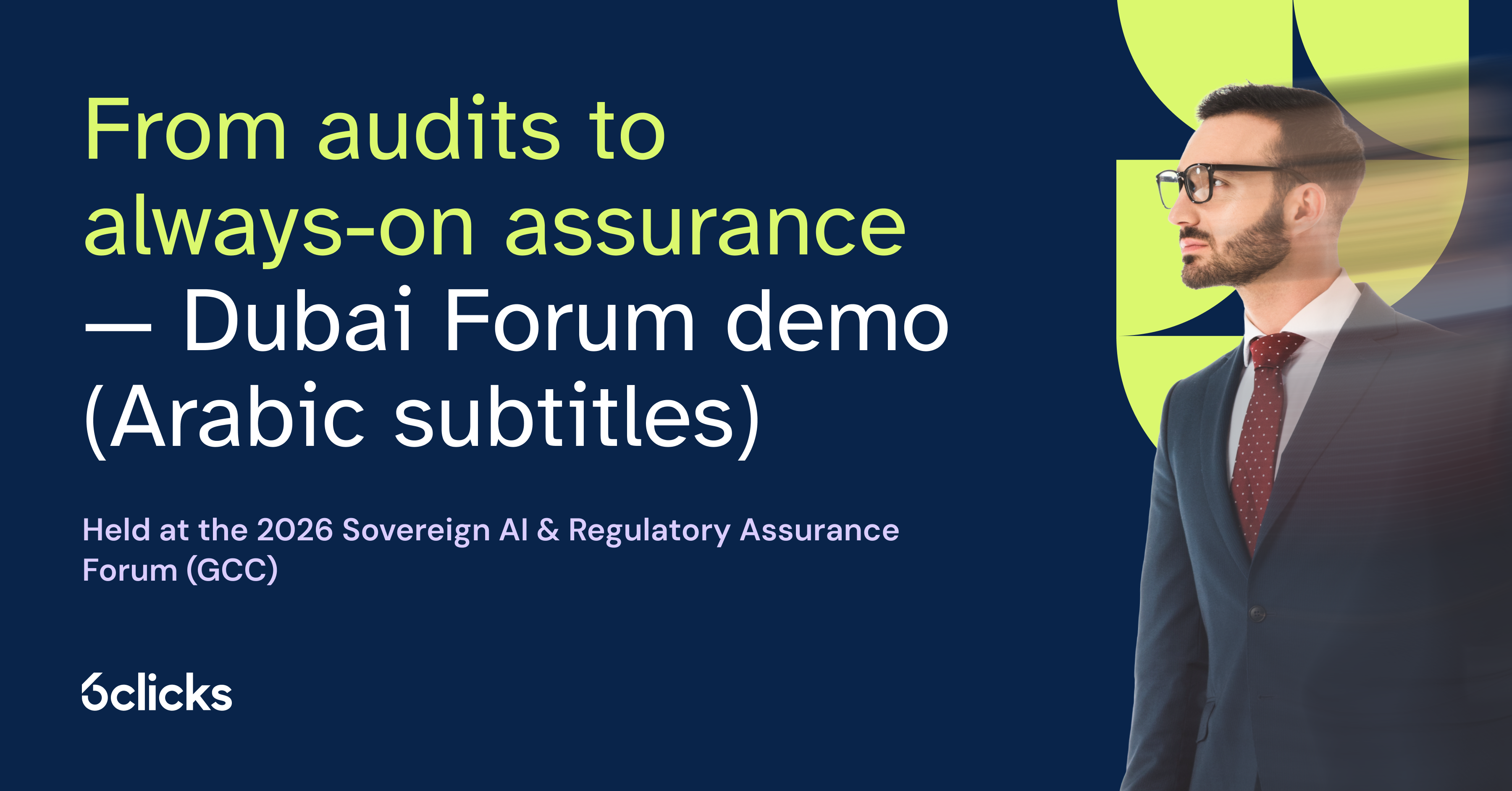
A practical walkthrough of moving from audits to continuous, always-on assurance for cyber and AI governance (Arabic subtitles): From audits to always-on assurance - Dubai Forum demo
What is ISO 42001 and why does it matter in the GCC?
ISO/IEC 42001:2023 is the first international standard specifically designed for AI management systems. It defines requirements for establishing, implementing, maintaining, and continually improving an AIMS within an organisation.
Unlike earlier technology governance standards that organisations could treat as optional or aspirational, ISO 42001 is on a path to becoming a contractual and regulatory requirement in government-adjacent procurement across the GCC — in the same way ISO 27001 became a baseline expectation for information security management over the past decade.
What ISO 42001 covers
- AI risk identification and assessment processes
- Governance structures for responsible AI deployment
- Controls for data quality, model transparency, and explainability
- Supplier and third-party AI risk management
- Continual improvement and audit readiness mechanisms
Who needs to act first
Organisations with the highest compliance exposure include:
- Technology vendors and system integrators supplying to GCC government entities
- Financial services organisations operating under UAE Central Bank or Saudi Central Bank oversight
- Critical infrastructure operators in energy, water, and transport sectors
- Healthcare and public sector technology providers
The governance gap: why AI adoption speed creates assurance risk
The compliance challenge in the GCC is structural. When governments are the world's most aggressive AI adopters, the organisations supplying to and supporting those governments are pulled into AI deployment faster than their internal governance frameworks can accommodate.
This creates three distinct assurance risks:
- Undocumented AI use: Organisations deploy AI tools without formal risk assessments, control frameworks, or audit trails. When regulators or procurement bodies ask for evidence of governance, there is nothing to show.
- Framework fragmentation: Some organisations apply their ISO 27001 or NIST controls to AI risks as an afterthought. This creates gaps because those frameworks were not designed for AI-specific risks such as model bias, data provenance, and explainability obligations.
- Supplier chain exposure: Even if your own AI deployment is governed, your suppliers and subcontractors may not meet the same standard. GCC government procurement is increasingly requiring evidence of third-party AI governance as a condition of contract.
What a defensible AI governance programme looks like in the GCC context
Building a defensible governance, risk, and compliance programme for AI in the GCC does not require starting from scratch. Organisations with existing GRC infrastructure — ISO 27001 certification, risk registers, and audit workflows — can extend those capabilities to cover AI governance systematically.
Step 1: Map your AI inventory
Document every AI system in use across your organisation: what it does, who owns it, what data it processes, and what decisions it influences. This is the foundational step for any ISO 42001 implementation and the most common gap auditors identify.
Step 2: Conduct an AI risk and gap assessment
Assess each AI system against ISO 42001 requirements. Identify which controls are already met by your existing GRC programme and which require new or extended controls. Pay particular attention to:
- Data quality and lineage controls
- Model explainability and audit trail requirements
- Human oversight mechanisms for high-risk AI decisions
Step 3: Build cross-framework control mapping
Map ISO 42001 controls against your existing frameworks — ISO 27001, NIST Cybersecurity Framework, or relevant UAE and Saudi national cybersecurity frameworks. Cross-framework mapping avoids duplication of effort and demonstrates to auditors that your GRC programme is integrated, not siloed.
Step 4: Establish continuous monitoring and evidence collection
AI governance is not a point-in-time audit exercise. Regulators and procurement bodies in the GCC are moving toward continuous assurance models. Both manual and automated evidence collection must be built into your programme from the outset — not bolted on before an audit.
Step 5: Extend vendor risk management to cover AI suppliers
Review your Vendor Risk Management programme to include AI-specific due diligence questions. For each AI supplier, assess their own governance posture, data handling practices, and certification status.
Andrew Robinson (Co‑Founder, 6clicks) shares practical steps to assess AI risks, build trust, and align with ISO/IEC 42001.
How 6clicks helps organisations in the GCC stay audit-ready
6clicks is built as Sovereign GRC Infrastructure — designed to work in the environments where compliance obligations are most demanding, including air-gapped, hybrid, and government-adjacent deployments that other GRC platforms cannot reach.
For organisations managing AI governance obligations in the GCC, 6clicks provides:
- Pre-built ISO 42001 content in the 6clicks Content Library — control sets, assessment templates, and policy libraries aligned to the standard, ready to deploy without manual build time.
- Cross-framework control mapping across ISO 42001, ISO 27001, NIST AI RMF, and regional frameworks — so organisations can demonstrate integrated governance without duplicating effort.
- Hub & Spoke architecture that supports multi-entity and multi-jurisdiction programmes — critical for organisations operating across GCC member states with different regulatory requirements.
- Audit & Assessment workflows that support both manual and automated evidence collection — meeting the continuous assurance expectations of government procurement bodies.
- Vendor Risk Management capabilities that extend AI governance due diligence across your supplier chain.
6clicks deploys on your terms, including in sovereign cloud, on-premises, hybrid, and air-gapped environments. This matters in the GCC, where government data sovereignty requirements are a non-negotiable condition of many contracts.
Always audit-ready. GRC that works where others can't.
Frequently asked questions
Next step
If your organisation operates in the GCC or supplies to government-adjacent sectors in the region, the time to act on AI governance is now — before ISO 42001 compliance becomes a contractual gate rather than a competitive advantage.
Book a demo to see how 6clicks can accelerate your ISO 42001 implementation and extend your existing GRC programme to cover AI governance obligations in the Middle East.