
Australia’s Security of Critical Infrastructure (SOCI) Act was designed to raise the bar for cyber and operational risk governance across Australia’s critical infrastructure sectors. Since its introduction, SOCI has helped formalise expectations around how organisations manage risk, report incidents, and evidence effective control performance.
The SOCI Act establishes mandatory governance, risk, and security obligations for organisations operating essential services in Australia.
Now, as the Home Affairs SOCI Act review consultation is underway, a clear theme is emerging. Many operators are reaching the limits of compliance as a tick-box exercise. Instead, they’re looking for governance approaches that deliver real-world visibility, defensible evidence, and efficiency at scale.
This shift matters not just for regulators, but for safety, resilience, and long-term performance of our critical infrastructure.
Across critical infrastructure sectors, this is driving a shift from document-based compliance toward operational, evidence-led governance.
Why SOCI matters now
SOCI gives operators flexibility in how they meet their obligations. Teams can align with ISO 27001, ASD’s Essential Eight, the Information Security Manual (ISM), or other recognised frameworks. On paper, that flexibility makes sense.
In practice, however, it has led to widely different outcomes across sectors and even within individual organisations.
Some teams have mature, evidence-driven controls. Others struggle to articulate implementation or provide evidence beyond static spreadsheets and policy documents. This variability can create blind spots in risk management, inconsistent reporting, and fragile assurance over time.
Add in the ongoing consultation on the Independent Review of the SOCI Act, and organisations are signalling that the real challenge isn’t checking a box. It’s ensuring controls are effective, connected to risk, and visible across the entire operating environment. The industry conversation is shifting from compliance theatre to operational governance that actually works.
From documents to operational controls
Across critical infrastructure sectors, operators are wrestling with similar problems:
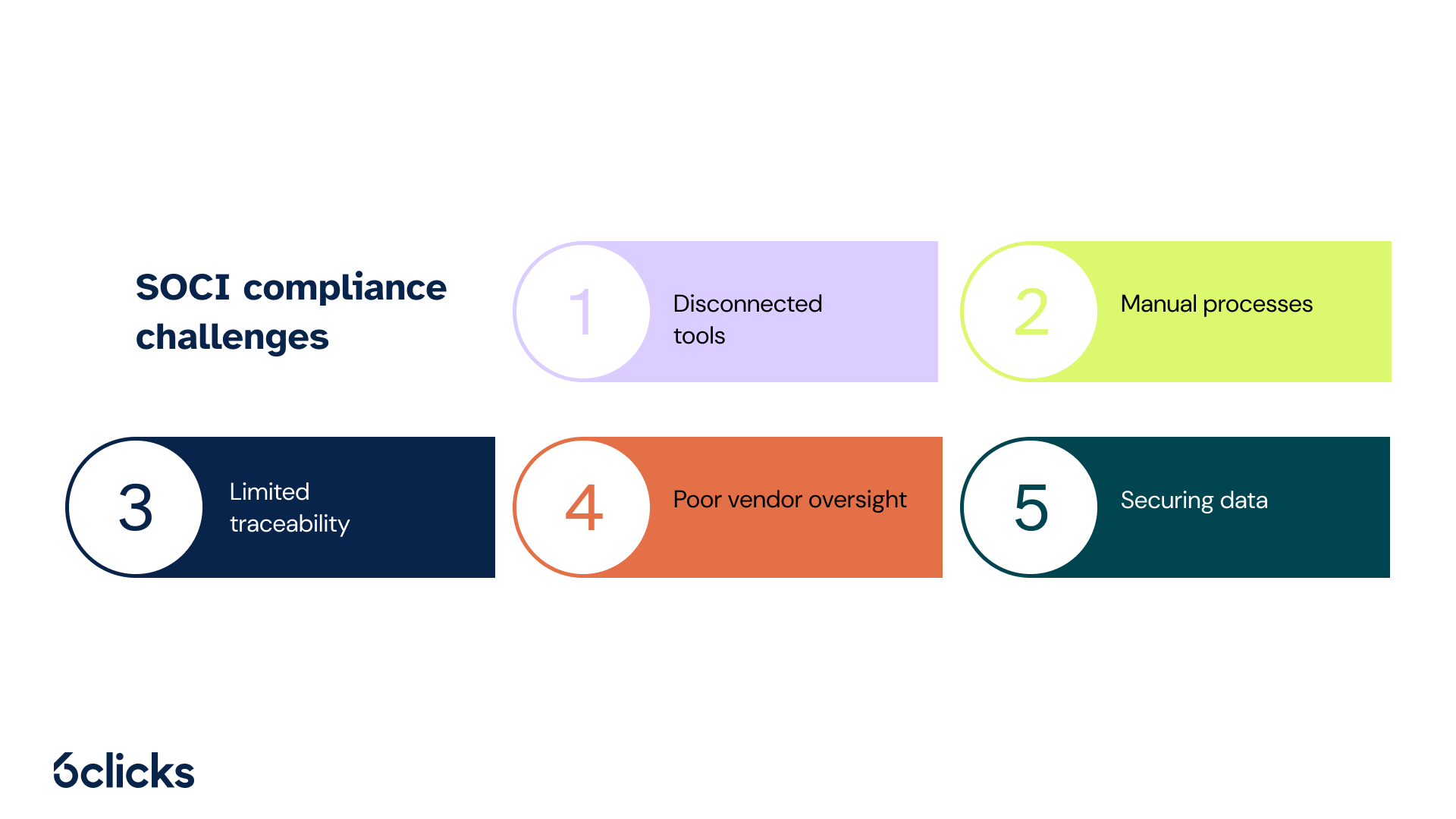
- Siloed evidence held in shared drives and spreadsheets
- Manual workflows for risk, control assessments, and reporting
- Limited linkage between risks, controls, and underlying assets
- Challenges consolidating supplier risk and third-party evidence
- Maintaining the confidentiality of risk management plans and security performance data
These issues aren’t unique to one sector. Whether energy, water, telecommunications, or transport, teams report that traditional compliance tools struggle to scale with SOCI’s intent and real-world complexity.
At the same time, expectations are rising. Regulators and boards want evidence, not anecdotes. They want traceable proof that a control works in practice, not just a policy statement.
This demand is why many operators are reconsidering how they manage governance, risk, and compliance end-to-end, rather than relying on static checklists.
Why traditional approaches fall short
Manual processes and generic tools can work at a small scale. SOCI environments are neither small nor simple.
SOCI is asset-centred and multi-entity by design. That creates three common breakdowns.
First, evidence becomes static. Teams gather documentation for audits, then return to business as usual. As systems, suppliers, and risks evolve, evidence quickly becomes outdated.
Second, workflows become disconnected. Risks, controls, and evidence live in different places, making it difficult to demonstrate how a specific control mitigates a specific risk.
Third, supplier visibility remains partial. Supply chains and third parties are risk multipliers. When evidence is fragmented, reporting becomes fragile and reactive.
The net result isn’t confidence. It’s manual drag, risk blind spots, and audit pressure that distracts from real operational outcomes.
What modern governance looks like under SOCI
Forward-looking teams aren’t just chasing compliance. They are building governance systems designed for operational reality.
Modern SOCI governance typically enables teams to:
- Link risk directly to controls and supporting evidence
- Capture evidence in context through live workflows
- Provide up-to-date visibility for executives and boards
- Support multi-entity and asset-level reporting
This shift aligns with how policy and regulatory expectations are evolving. The SOCI Act consultation increasingly points toward consistency, clarity, and operational depth in how obligations are met.
Rising reporting obligations
Under the SOCI Act, mandatory cyber and incident reporting applies to all responsible entities that own or operate critical infrastructure assets. These baseline reporting obligations apply across all sectors in scope, including health, education, water, energy, and transport.
Assets declared as Systems of National Significance (SoNS) may be subject to additional enhanced cyber security obligations too, raising the level of assurance and visibility required for assets deemed critical to Australia’s national security, economy, or social stability.
As governance practices mature across critical infrastructure sectors, there is a growing need for consistent, timely, and well-structured reporting that supports regulatory oversight, sector-wide resilience, and coordinated response. Strong reporting capabilities help reduce weakest-link risk in highly interconnected environments and enable operators to demonstrate accountability with confidence.
SOCI as a catalyst for better governance
Rather than being purely a regulatory burden, SOCI is increasingly acting as a catalyst for governance innovation.
Organisations that move beyond checklists and focus on control effectiveness, evidence linkage, and automation are better positioned to:
- Build systems that are resilient
- Respond to risks and incidents proactively
- Demonstrate compliance as a byproduct of operating
- Build trust with boards and regulators
- Reduce low-value manual governance work
In this context, SOCI is not just a compliance act. It is a driver of resilient, scalable governance that keeps pace with threats and regulatory change. With 6clicks, critical infrastructure operators can streamline SOCI alignment with a unified platform that offers purpose-built multi-entity architecture and complete risk and compliance functionality, centralising evidence and automating manual processes like reporting, control mapping, and assessments to help you achieve compliance faster and with greater confidence.
Final thoughts
Australia’s critical infrastructure operators are entering the next phase of SOCI maturity. One where governance is embedded into everyday operations, rather than rebuilt for each audit or review cycle.
As the SOCI Act review continues, this shift toward operational governance will be critical for organisations seeking to meet regulatory expectations while strengthening performance, confidence, and public trust. And the organisations that leverage modern platforms like 6clicks are positioned to thrive in this continuously evolving regulatory environment.